
playbooks
Cold Email Playbook for AI Agencies Using Instantly
A practical cold email workflow for AI agencies: positioning, list building, deliverability, campaign structure, reply handling, and content flywheel ideas.
On this page
Cold email can work for AI agencies, but only when it is treated as a market-learning system. The goal is not to send as many messages as possible. The goal is to discover which buyers have urgent problems, which offer earns trust, and which proof turns a reply into a sales conversation.
This playbook uses Instantly as the outbound layer, but the operating model matters more than the tool. You can use the same logic with any sales engagement platform.
The Right Starting Point
Start with one narrow offer:
| Weak offer | Stronger offer |
|---|---|
| We help companies with AI | We reduce support ticket volume for B2B SaaS teams using AI triage |
| We build chatbots | We build website chat systems that qualify inbound leads for local clinics |
| We automate workflows | We automate invoice intake for accounting teams using existing tools |
Specificity helps every part of outbound: list building, subject lines, personalization, proof, follow-up, and sales calls.
Campaign Setup
Use this simple structure for the first campaign:
- Define one ICP.
- Build a 200-500 lead list with visible fit signals.
- Write one primary pain-led email.
- Write two short follow-ups.
- Use one proof point or concrete observation.
- Send conservatively while watching bounces and complaints.
- Route all replies into a same-day follow-up workflow.
The first campaign is not about scale. It is about signal.
Lead Qualification Signals
Good cold email starts before the email. For an AI agency, a lead should have at least one reason to care now:
- Hiring for a role that your automation could support.
- Publishing content about the workflow you improve.
- Using a tool stack that creates integration opportunity.
- Growing fast enough that manual operations may be breaking.
- Showing a visible website, support, sales, or operations bottleneck.
Add a short research note to each account. That note becomes the anchor for personalization.
Message Formula
Use a plain structure:
| Part | Job |
|---|---|
| Context | Show why this message is relevant to the recipient |
| Pain | Name one specific operational friction |
| Outcome | Describe the business result, not the AI technique |
| Proof | Add a short example, audit note, or credible observation |
| CTA | Ask for a small next step |
Avoid hype words like “revolutionize,” “10x,” and “fully autonomous” unless you can prove them. Buyers do not need more AI excitement. They need less risk.
Deliverability Guardrails
Before sending, verify the basics:
- SPF, DKIM, and DMARC are configured for sending domains.
- The sender identity is clear.
- The message is accurate and not misleading.
- Unsubscribe handling is available where required.
- New domains and inboxes are ramped gradually.
- Bounces, spam complaints, and replies are reviewed daily.
Mailbox providers care about recipient experience. A relevant email to a narrow audience is safer than a generic pitch to a giant list.
Reply Handling
Most agencies lose deals after the reply, not before it. Create reply categories before the campaign starts:
| Reply type | Next action |
|---|---|
| Interested | Send a short, specific meeting link and one relevant proof point |
| Not now | Ask when the workflow becomes a priority and set a reminder |
| Already solved | Ask what they use and capture competitor insight |
| Wrong person | Ask who owns the workflow |
| Objection | Save the exact wording for future copy and FAQ content |
This creates a feedback loop. Every reply improves the next campaign.
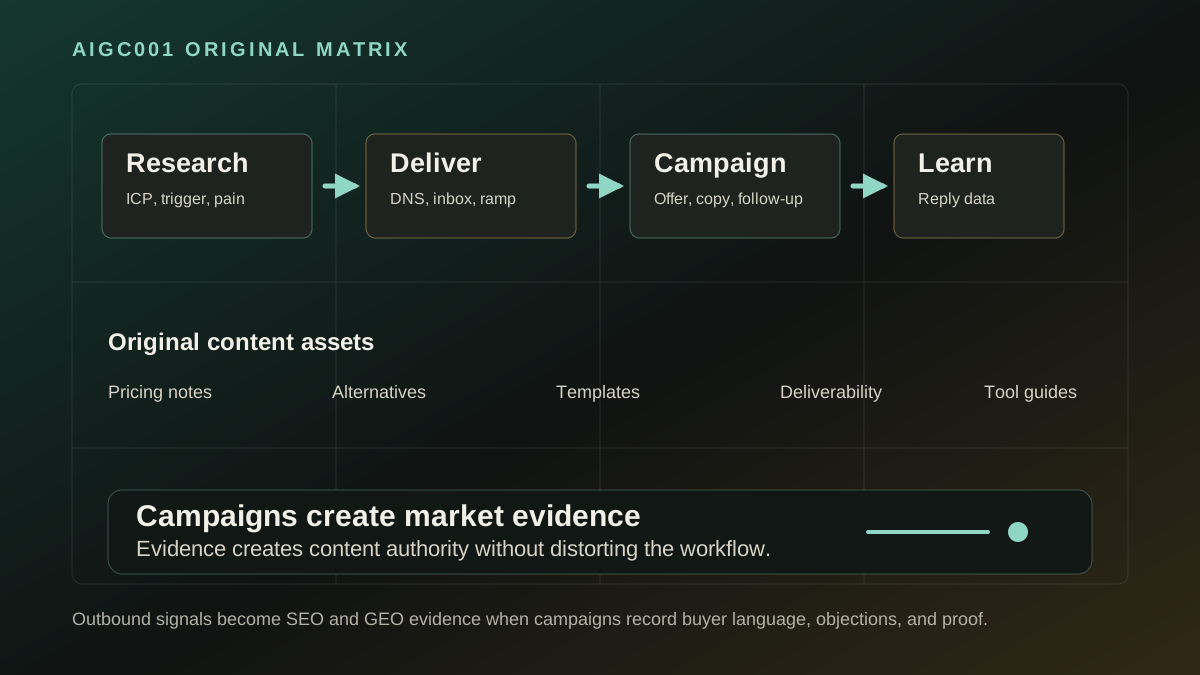
Turn Outbound Into SEO/GEO Content
The best content does not come from guessing keywords. It comes from real buyer conversations. After every campaign, summarize:
- The top pains prospects mentioned.
- The objections that appeared repeatedly.
- The industries that replied most often.
- The phrases buyers used to describe the problem.
- The proof points that increased booked calls.
Then publish original assets:
- A review of the tool stack used to run the campaign.
- A niche-specific AI automation guide.
- A comparison of manual process vs AI-assisted workflow.
- An anonymized campaign teardown.
- A buyer FAQ based on real objections.
That is how outbound supports SEO and generative engine optimization. Search engines and AI answer engines both need specific, experience-based information that is hard to copy from product pages.
FAQ
How many cold email campaigns should an AI agency start with?
Start with one narrow campaign and one clear ICP. A small, carefully reviewed list usually teaches more than a large generic send.
What is the most important cold email metric?
Qualified replies are more useful than open rates. Track positive replies, booked calls, no-shows, and revenue.
Should AI agencies use AI to write every cold email?
AI can help with research, drafts, summaries, and reply classification, but humans should control the offer, claims, compliance posture, and final messaging.
Related Reading
- Instantly review
- Instantly pricing guide
- Cold email deliverability checklist
- AI agency cold email templates
- Instantly tool profile
- Best recurring affiliate tools for AI businesses
Next step
Work out your outbound budget
Separate outreach, lead credits, and mailbox costs before choosing a plan.
Read the Instantly pricing guide